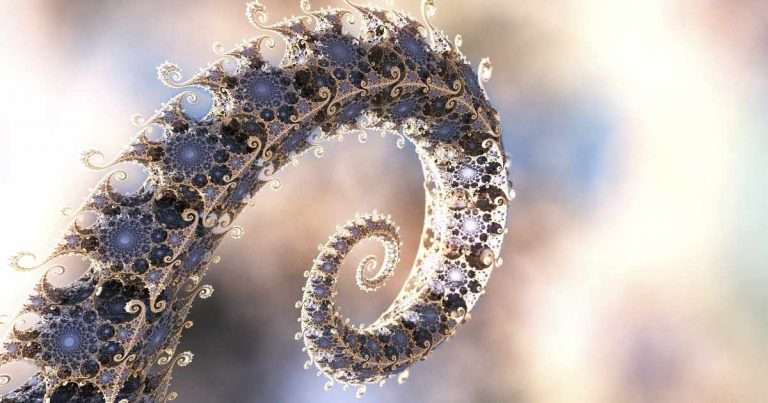
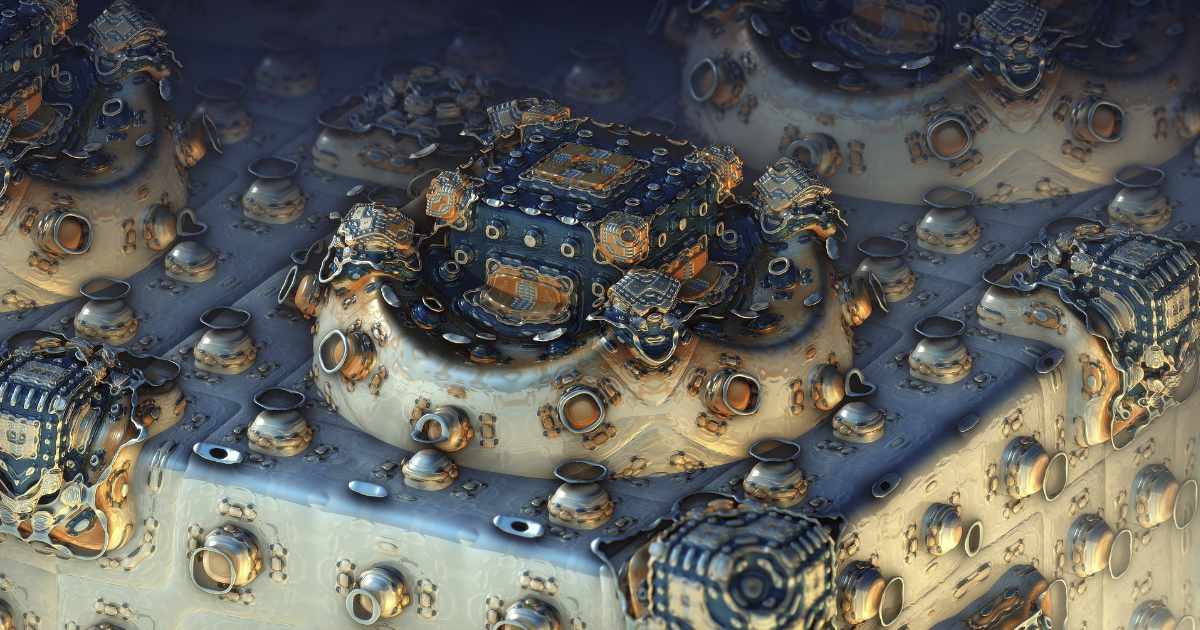
If you’ve read my article about Fractal Art and found yourself fascinated, Mandelbulb will blow your mind!
The Mandelbulb is a three dimensional manifestation of the Mandelbrot set. It is an infinitely complex, naturally occurring fractal object.
The two dimensional Mandelbrot set, discovered in the early 20th century, is named for the mathematician Benoit Mandelbrot—the ‘Father of Fractal Geometry’—who studied and popularized it.
The Mandelbrot Set is the most widely recognized mathematical fractal form. Along with fractal geometry, it entered popular culture in the mid 1980s. About thirty years passed between the first digital rendering of the flat Mandelbrot set in the late 1970s and the first rendering of its three dimensional equivalent, the Mandelbulb, in 2009.
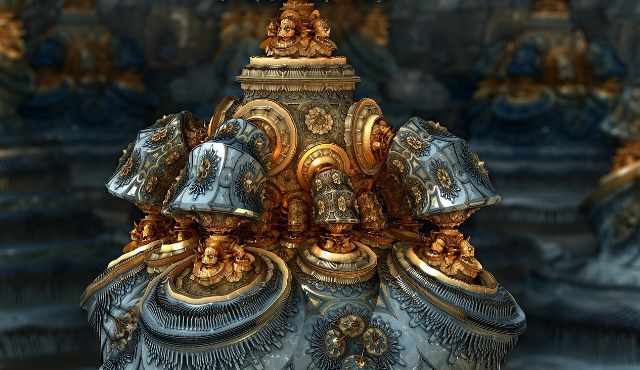
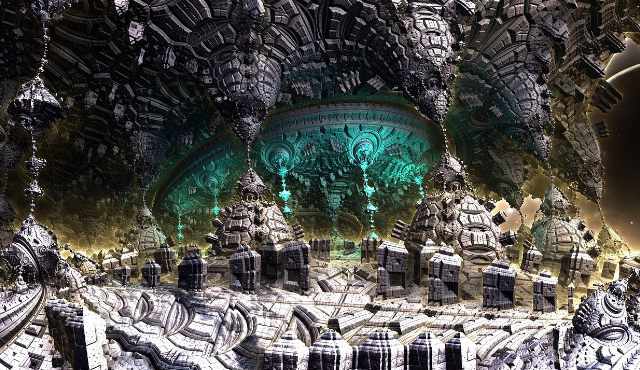
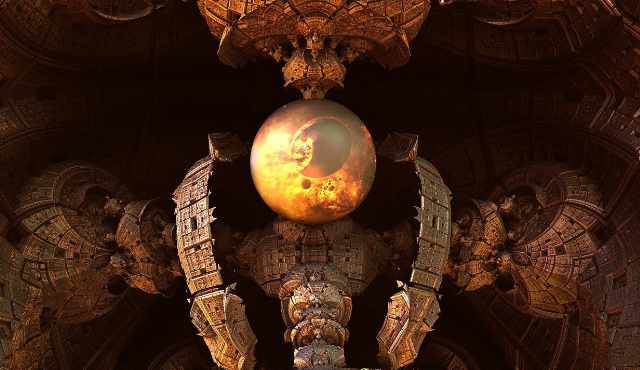
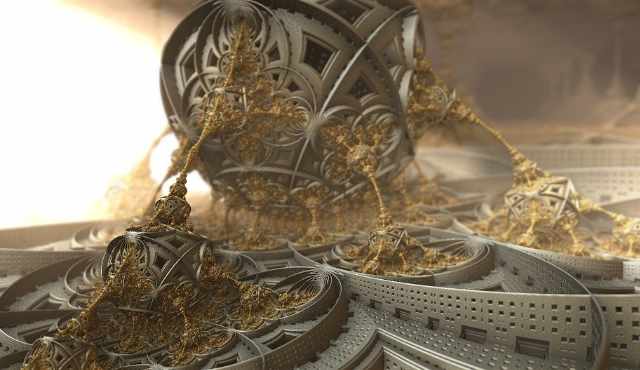
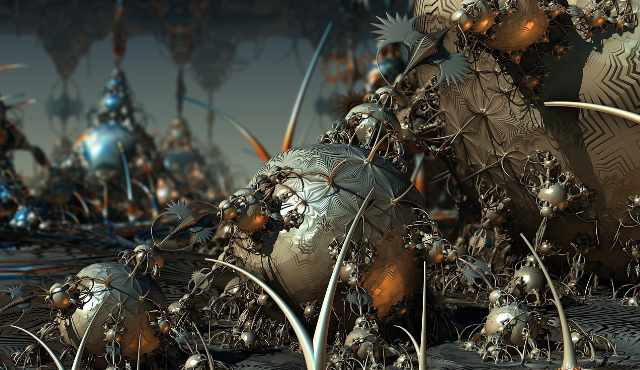
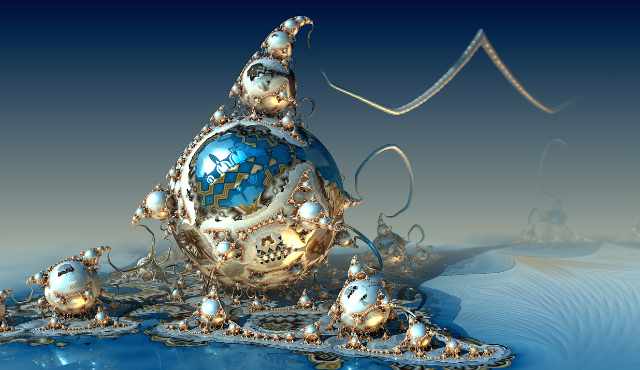
The Mandelbulb was discovered by Daniel White and Paul Nylander, and developed collaboratively in the Fractal Forums community. These individuals set out to find a three-dimensional equivalent of the Mandelbrot set, and they found what they were looking for.
Using a spherical coordinate system, and some ingenious math, White and Nylander projected the Mandelbrot set into three dimensions, creating the Mandelbulb. In 3D-space, we see a more fully realized rendering of the Mandelbrot set. While the flat set exhibits infinite complexity, the Mandelbulb reveals that complexity in a fuller magnitude.
The Mandelbulb is an archetypal fractal form, embodying principles of deterministic chaos. The Mandelbrot set is the “most complex object on the complex number plane” but arises from a simple formula, commonly expressed as Z = Z² + C

Here’s details of a favourite artist:
Matthew Haggett
Matthew, a longtime artist and designer, has been exploring 3D fractal art since March of 2012. He was a competitive mathematician in high school, and has been a fractal geometry enthusiast since the late 1980s. With BA and MFA degrees in art and regular solo shows, Matthew has been a staple of the Portland, Oregon art scene since the 1990s. Matthew works in Mandelbulber and MB3D, with image mastering in Adobe Photoshop. In his 3D fractal art, he uses the same compositional techniques from his paintings to create dynamic, visually engaging images. A synthesis of math and art principles, his explorations of 3D fractals take some very interesting turns.
Here is a tutorial from Don Whitaker to give you an idea of just what can be done with this incredible type of 3d graphics.
If you’d like to see some of Mathew’s work, Click Here